
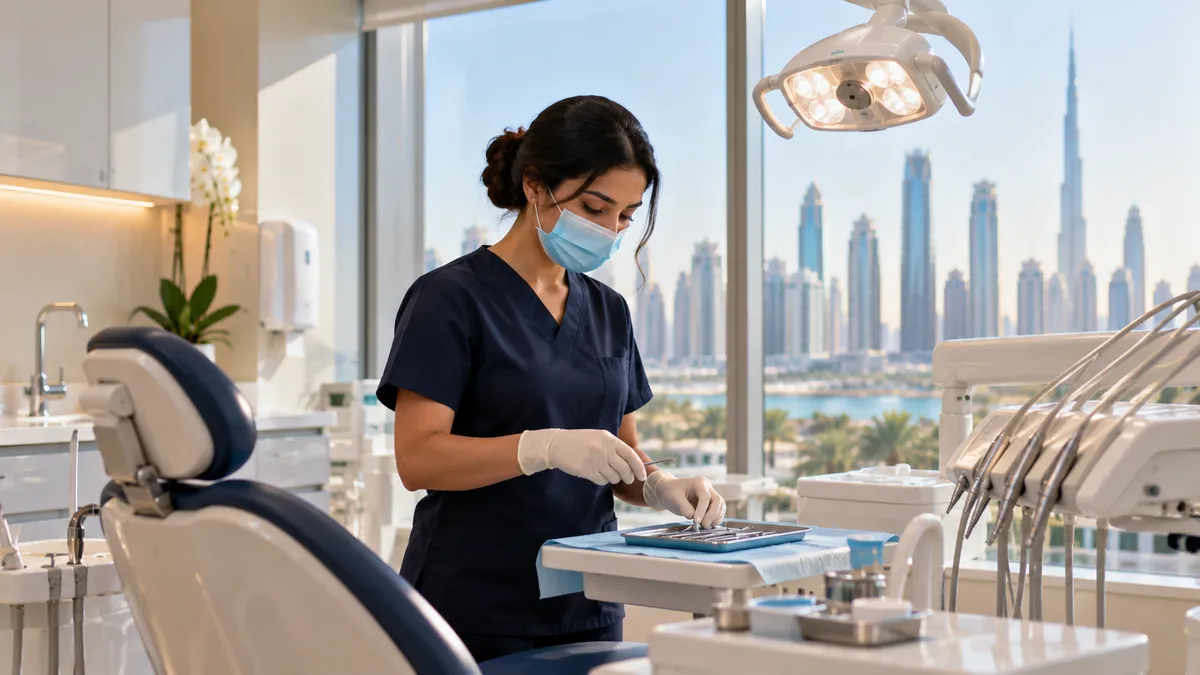
What is the DHA general dentist exam?
The DHA General Dentist exam (code GEN5301) is the computer-based test dentists sit to be licensed as a general dentist by the Dubai Health Authority. It has 150 multiple-choice questions in 3 hours, the pass score is 60%, and it is delivered by Prometric worldwide. The result is Pass or Fail only.
The exam format
| Exam code | GEN5301 (Dentists, General Dentist) |
|---|---|
| Questions | 150 multiple-choice questions (MCQs) |
| Time | 3 hours, which DHA says includes registration, the introduction and the exam itself |
| Pass score | 60% |
| Fee | USD 280, paid to Prometric when you book |
| Result | Pass or Fail in your Sheryan account, usually within 2 working days. The score is not shared. |
| Attempts | Up to 3 attempts. Failing the third attempt blocks a new DHA application for 2 years. |
Source: DHA Healthcare Professional Licensing Assessment Guideline (CBT, updated Sep 2026) and the DHA Manual for Professional Assessment v1.1, rules 4.6 to 4.10 and 7.2.14. DHA can change the content, format or pass score without updating the guideline, so check the current version before you book.
What the exam covers
The DHA guideline lists 12 coverage areas for General Dentist:
- Anaesthesia and pain management
- Oral medicine and oral surgery
- Periodontics
- Temporomandibular joint
- Endodontics
- Implant surgery
- Restorative dentistry
- Orthodontics and paediatric dentistry
- Cosmetic dentistry
- Deformities and orthognathic surgery
- Patient education
- Ethics
Our 105 questions are grouped into 9 practice topics. Cosmetic topics such as bleaching sit under restorative dentistry, and we have added medical emergencies in the dental chair, which the DHA reference list covers through Malamed's Medical Emergencies in the Dental Office.
Free official resources, and what we add
DHA publishes the topic list and a reference list (Neville's Oral and Maxillofacial Pathology, Lang and Lindhe's Clinical Periodontology and Implant Dentistry, McDonald and Avery, Sturdevant, Pathways of the Pulp, Malamed's local anaesthesia and medical emergencies handbooks, and Fonseca's trauma text) but no official practice questions. We add original clinical questions at licensing level, each with an explanation and its source.
How to prepare
- Read the General Dentist page of the DHA CBT guideline and note the 12 coverage areas and the reference books.
- Take the 5 free questions to see the style: short clinical scenarios with one best answer.
- Revise the classifications examiners like: G.V. Black, Kennedy, Glickman and the 2017 periodontal staging and grading.
- Practise local anaesthetic dose calculations until they are quick and accurate.
- Know the emergency drugs and doses for fainting, angina, anaphylaxis, asthma and hypoglycaemia.
- Sit timed mock exams so the pace of the real exam feels normal.
Practice questions with answers
Tap a question to see the correct answer and explanation.
Which oral mucosal lesion carries the highest risk of malignant transformation?
- Homogeneous leukoplakia
- Erythroplakia
- Frictional keratosis
- Linea alba
Answer: B, Erythroplakia. Erythroplakia (a fiery red patch that cannot be characterised as any other condition) shows dysplasia or carcinoma in most biopsies and has the highest transformation risk of the potentially malignant disorders. Homogeneous leukoplakia carries a much lower risk, and frictional keratosis and linea alba are reactive. Source: Neville et al., Oral and Maxillofacial Pathology, epithelial pathology chapter.
What is the main advantage of high-copper dental amalgams over conventional low-copper alloys?
- They contain no mercury
- They eliminate the weak, corrosion-prone gamma-2 phase
- They bond chemically to dentine
- They release fluoride over time
Answer: B, They eliminate the weak, corrosion-prone gamma-2 phase. In high-copper amalgams, copper reacts with tin so that the tin-mercury gamma-2 phase, which is weak and corrodes easily, does not form. This improves strength and marginal integrity. Amalgam still contains mercury and does not bond or release fluoride. Source: Sturdevant's Art and Science of Operative Dentistry, amalgam restorations.
A patient has spontaneous pain in a lower molar, and cold testing causes pain that lingers for over a minute after the stimulus is removed. What is the pulpal diagnosis?
- Symptomatic irreversible pulpitis
- Reversible pulpitis
- Pulp necrosis
- Normal pulp
Answer: A, Symptomatic irreversible pulpitis. Lingering pain to thermal stimuli and spontaneous pain indicate symptomatic irreversible pulpitis, treated by pulpectomy (or pulpotomy in selected cases) or extraction. In reversible pulpitis the pain stops within seconds of removing the stimulus. Source: AAE Consensus Conference diagnostic terminology; Cohen and Hargreaves, Pathways of the Pulp.