
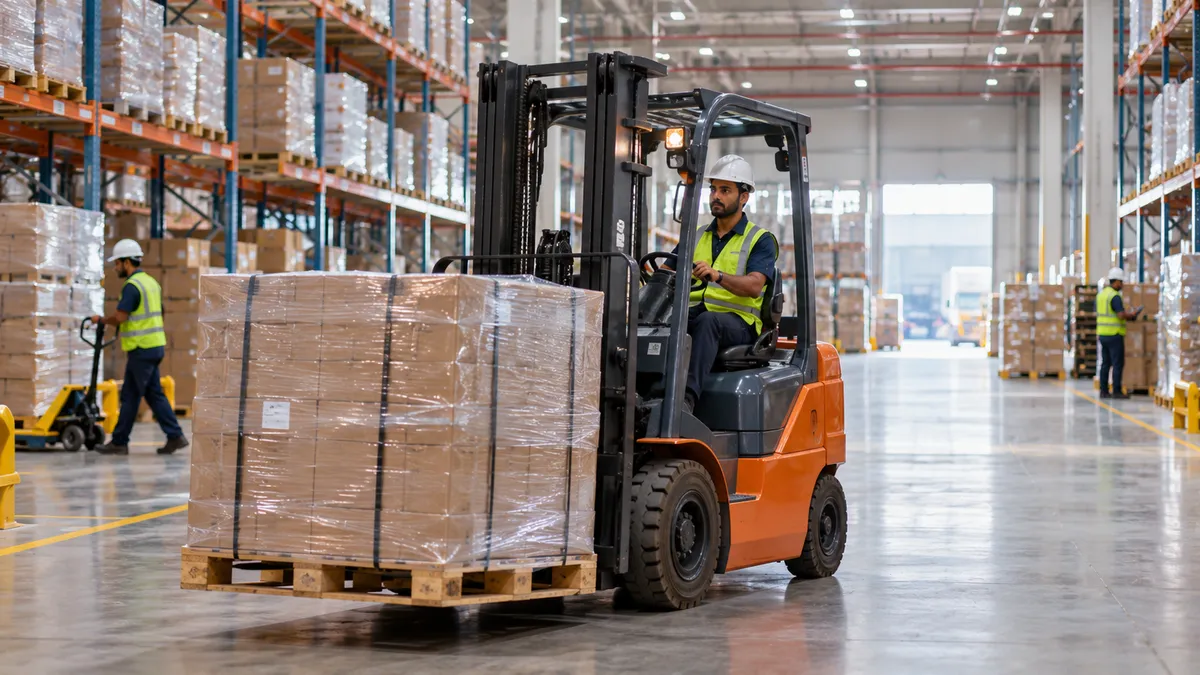
What is the RTA forklift and light equipment licence test?
In Dubai, forklifts and similar machines fall under the RTA light equipment and heavy equipment licence categories. After opening a traffic file and getting a learning permit, you attend 4 hours of theory lectures at a driving institute, then take the knowledge test, followed by the yard and road tests. The minimum age is 20.
The exam format
| Licence categories | Light equipment; heavy equipment (tractors and equipment) |
|---|---|
| Minimum age | 20 |
| Before the test | 4 hours of theory lectures for light or heavy equipment |
| Tests | Knowledge test, yard test, road test |
| Documents | Valid Emirates ID and a valid eye test from an accredited eye test centre (valid 3 years) |
| Learning permit | Needed to book tests; AED 200 for equipment categories |
RTA's knowledge test FAQ gives 40 questions with 30 correct needed to pass, but it does not say whether the equipment test differs, and RTA publishes no equipment handbook. Our questions therefore cover the forklift safety knowledge the theory lectures and yard test check, taken from recognised standards.
What the exam covers
- Equipment types and controls: counterbalance and reach trucks, tilt, side shift, capacity plates
- Pre-use inspection: forks, chains, hydraulics, brakes, horn, tyres and seat belts
- Load centre and stability: the stability triangle and how capacity falls as the load centre grows
- Lifting, stacking and travelling: carrying loads low, tilting, reversing with large loads
- Pedestrians and site traffic: segregation, blind corners, nobody under raised forks
- Ramps, docks and surfaces: load uphill on slopes, chocked trailers, dock plates
- Battery, LPG and fuel safety: hydrogen, acid into water, cylinder changes
- Emergencies and tip-over: stay in the seat, brace and lean away
- RTA licence rules: age, lectures, eye test and tests
Free official resources, and what we add
RTA's service pages on rta.ae explain the licence steps, and international regulators such as OSHA and the UK HSE publish free forklift safety guidance. There is no official question bank for the equipment test. Our 106 questions are original, grouped into 9 topics, include load-centre calculations with the working shown, and every explanation names its source.
How to prepare
- Learn the RTA steps: traffic file, eye test, learning permit, 4 hours of lectures, then the tests.
- Understand the stability triangle and why raised loads and fast turns cause tip-overs.
- Practise load-centre questions: capacity falls as the load centre moves away from the forks.
- Memorise the pre-use check list and the rules for ramps and docks.
- Practise by topic, then take timed mock exams.
Practice questions with answers
Tap a question to see the correct answer and explanation.
What keeps a counterbalance forklift from tipping forward when it lifts a load?
- The weight of the operator alone
- A heavy counterweight at the rear
- Suction pads under the forks
- Outriggers that touch the floor
Answer: B, A heavy counterweight at the rear. A counterbalance truck uses a heavy counterweight behind the rear axle to balance the load on the forks. Source: UK HSE L117, Rider-operated lift trucks: operator training and safe use (Approved Code of Practice and guidance).
During a pre-use check you find a crack at the heel of one fork. What should you do?
- Use it for light loads only until the workshop can look at it
- Swap the forks over so the cracked one takes less weight
- Take it out of service and report it
- Finish the shift, then report it
Answer: C, Take it out of service and report it. Any truck found defective or unsafe must be taken out of service until repaired. A cracked fork can fail suddenly. Source: US OSHA standard 29 CFR 1910.178 (Powered industrial trucks), paragraph (p)(1).
What is the "load centre"?
- The total weight of the load including the pallet
- The distance from the fork face to the load's centre of gravity
- The middle of the warehouse
- The height of the forks above the floor when the load is raised
Answer: B, The distance from the fork face to the load's centre of gravity. The load centre is measured horizontally from the vertical face of the forks to the centre of gravity of the load. Source: the truck's capacity (data) plate and manufacturer's load chart; HSE L117.