
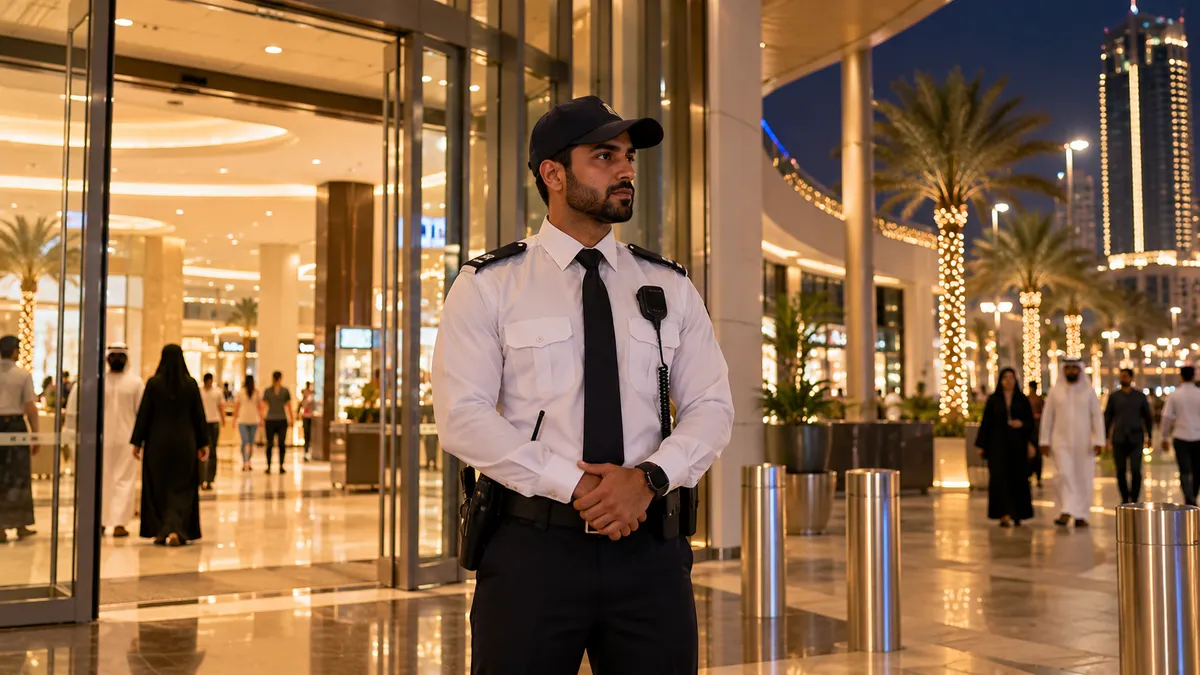
What is the SIRA security guard exam?
In Dubai, no one may provide security services without a licence under Law No. (12) of 2016. The Security Industry Regulatory Agency (SIRA) licenses each guard through the Security Cadre Card. To get it, a guard completes the Security Guard course and tests at a SIRA-approved training centre, plus physical fitness, fire safety, life support and people of determination certificates.
The exam format
| Licence | SIRA Security Cadre Card (Security Guard category), valid 2 years |
|---|---|
| Age | 21 to 60 |
| Training | Security Guard course at a SIRA-approved training centre; commonly reported as 40 hours over 5 days |
| Other certificates | Physical fitness (valid 3 months), fire safety, life support, people of determination |
| Documents | Emirates ID, residency with the employing security company, Dubai Police good conduct certificate addressed to SIRA |
| Pass mark | Commonly reported as 60%; SIRA's current pages do not state it |
The application is made by a licensed security company, not by the guard. Applicants who do not yet meet every requirement can get a one-off 90-day Trainee Permit. In Abu Dhabi, guards are licensed by a different authority with its own rules; this page is for Dubai and SIRA.
What the exam covers
- The role and duties of a guard: handovers, post instructions, confidentiality and limits of authority
- Dubai security law and SIRA rules: licensing, the Cadre Card, transfers and fines
- Patrolling and access control: ID checks, tailgating, visitors, keys and suspicious items
- Observation and report writing: facts not opinions, descriptions and logbooks
- Emergencies and evacuation: 999, 998 and 997, assembly points and bomb threats
- Fire safety: the fire triangle, extinguisher types and the PASS method
- First aid and life support: CPR, AEDs, bleeding, choking and burns
- Customer service and serving people of determination
- Conflict handling and the legal limits on using force
Free official resources, and what we add
SIRA publishes the licence requirements on sira.gov.ae, and Law No. (12) of 2016 is on the Dubai Legal Portal. There is no official practice question bank. Our 106 questions are original, grouped into 9 topics, and each explanation names its source, from the SIRA licence rules and the law to fire safety and resuscitation guidelines.
How to prepare
- Learn the SIRA licence facts: 2-year card, age 21 to 60, the four certificates and the 3-month fitness certificate.
- Memorise the UAE emergency numbers: 999 Police, 998 Ambulance, 997 Civil Defence.
- Practise writing short, factual incident reports.
- Revise CPR: 30 compressions to 2 breaths at 100 to 120 per minute.
- Practise by topic, then take timed mock exams.
Practice questions with answers
Tap a question to see the correct answer and explanation.
What is the main purpose of a security guard at a site?
- To act as a police officer with full powers of arrest and search
- To deter, detect and report
- To punish people who break the site rules
- To replace the building's cleaning staff
Answer: B, To deter, detect and report. A guard protects people, property and information by being visible, detecting problems and reporting them. Guards do not have police powers. Source: standard security guarding practice.
Which Dubai law regulates the security industry and the work of SIRA?
- Law No. (7) of 2006
- Law No. (24) of 2018
- Law No. (13) of 2008
- Law No. (12) of 2016
Answer: D, Law No. (12) of 2016. Dubai Law No. (12) of 2016 Regulating the Security Industry in the Emirate of Dubai sets up SIRA and requires licensing. Law No. 7 of 2006 and Law No. 13 of 2008 are real estate laws. Source: Dubai Law No. (12) of 2016 Regulating the Security Industry in the Emirate of Dubai, Articles 1 and 5.
Why should patrol times and routes be varied?
- Because fixed routes are not allowed under the SIRA licence
- To make the shift go faster and keep the guard awake
- So patrols are unpredictable
- To avoid using the lifts
Answer: C, So patrols are unpredictable. Predictable patrols let offenders time their actions. Varying routes and times keeps the deterrent effect. Source: standard security guarding practice.