
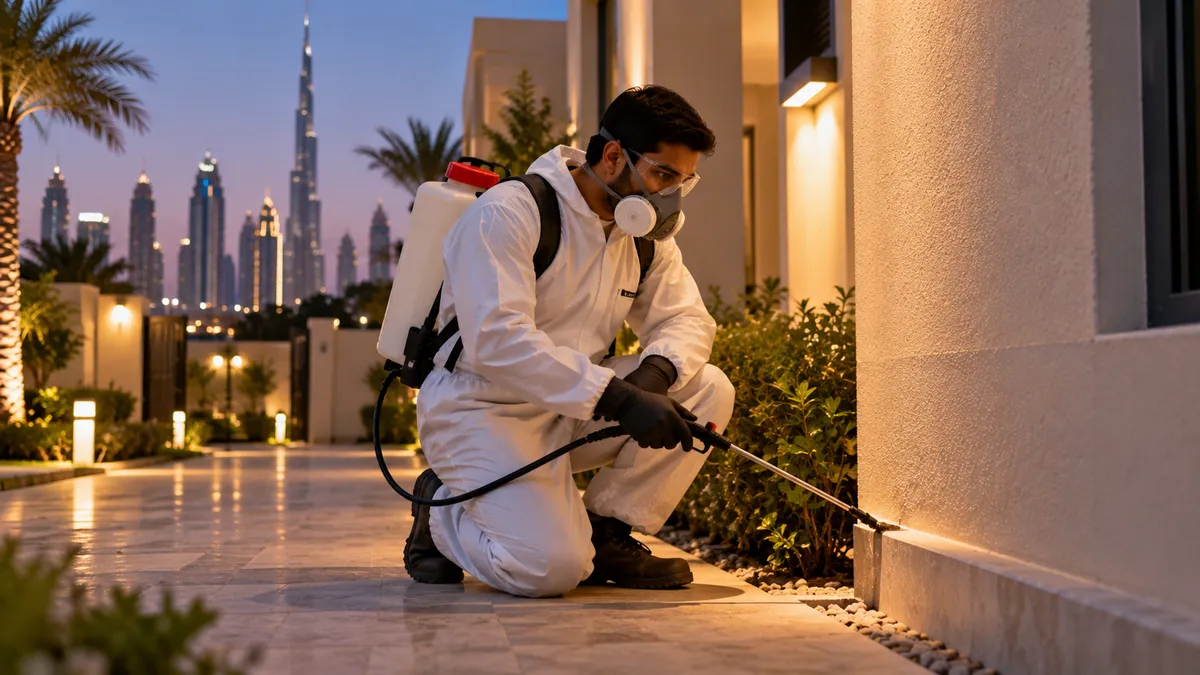
What is the Dubai pest control operator exam?
Dubai Municipality's Public Health Pest Control Section regulates and qualifies pest control companies in Dubai. Among its services, it accredits pest control supervisors and operators after they pass the Municipality's qualification test. Companies also need a No Objection Certificate from the Section before they can get a trade licence.
The exam format
| Run by | Dubai Municipality, Public Health Pest Control Section |
|---|---|
| Who takes it | Pest control operators and supervisors seeking DM accreditation |
| Question count and pass mark | Not published by Dubai Municipality |
| Company licensing | NOC from the Section before the trade licence |
| Licence scope | General pest control excludes fumigation, termite control and bird control, which need specific approval |
Dubai Municipality publishes a list of approved companies and has repeatedly warned the public not to use dangerous products such as aluminium phosphide themselves.
What the exam covers
- Public health pests: cockroaches, flies, mosquitoes, bed bugs, rodents, fleas, ticks and termites
- Integrated pest management: inspection, thresholds, sanitation, exclusion and monitoring
- Pesticide types and labels: pyrethroids, anticoagulants, IGRs, formulations, LD50 and hazard pictograms
- Safe handling, PPE and storage, including first aid
- Application equipment and calibration, with dilution and coverage calculations
- Fumigation safety: phosphine, sulfuryl fluoride, gas monitoring and clearance
- Food premises and residential treatments
- Environmental protection and disposal of containers and leftover mix
- Dubai Municipality rules for companies and operators
Free official resources, and what we add
Dubai Municipality publishes its pest control services, the approved company list and public guidance. WHO and FAO publish free guidance on vector control and pesticide management. There is no official practice question bank. Our 109 questions are original, grouped into 9 topics, and each explanation names its source. Dilution and calibration questions show the full working.
How to prepare
- Learn to identify the main pests and their life cycles: which have a pupal stage and which have nymphs.
- Understand IPM: inspect and identify first, use non-chemical methods, and treat only where needed.
- Practise dilution sums with C1 × V1 = C2 × V2, and sprayer coverage calculations.
- Know the first aid rules: 15 minutes of eye rinsing, wash skin with soap and water, never induce vomiting unless the label says so.
- Learn why aluminium phosphide is never used in homes and how fumigation sites are cleared.
- Practise by topic, then take timed mock exams.
Practice questions with answers
Tap a question to see the correct answer and explanation.
Which cockroach is small, light brown, has two dark stripes behind the head and is the most common indoor cockroach in kitchens?
- American cockroach (Periplaneta americana)
- German cockroach (Blattella germanica)
- Oriental cockroach (Blatta orientalis)
- Brown-banded cockroach (Supella longipalpa)
Answer: B, German cockroach (Blattella germanica). The German cockroach is about 12 to 15 mm long, light brown with two dark parallel stripes on the pronotum, and lives indoors in warm, humid areas such as kitchens. The American cockroach is much larger and reddish-brown, often in drains and sewers. Source: WHO, Vector control: methods for use by individuals and communities (Rozendaal, 1997), chapter on cockroaches.
What is the correct first step in an IPM programme for a new client site?
- Inspection and correct identification of the pest
- Applying a residual spray to all rooms
- Fogging the whole building
- Setting bait stations everywhere without a survey
Answer: A, Inspection and correct identification of the pest. IPM starts with inspection and accurate identification, because the biology of the pest determines where to look and which methods will work. Source: FAO/WHO International Code of Conduct on Pesticide Management (2014), Article 2; WHO, Pesticides and their application for the control of vectors and pests of public health importance (6th ed., 2006).
How do second-generation anticoagulant rodenticides such as brodifacoum differ from first-generation ones such as warfarin?
- They act within minutes
- They have no antidote at all
- They can kill after a single feed
- They work only on mice
Answer: C, They can kill after a single feed. Second-generation anticoagulants (brodifacoum, bromadiolone, difenacoum) are lethal after a single feed, while first-generation ones (warfarin, coumatetralyl) need several feeds. Both act slowly over days. Source: WHO, Pesticides and their application for the control of vectors and pests of public health importance (6th ed., 2006), rodenticides.